Disclaimer: This article is intended solely for informational and educational purposes only. It does not constitute medical advice.
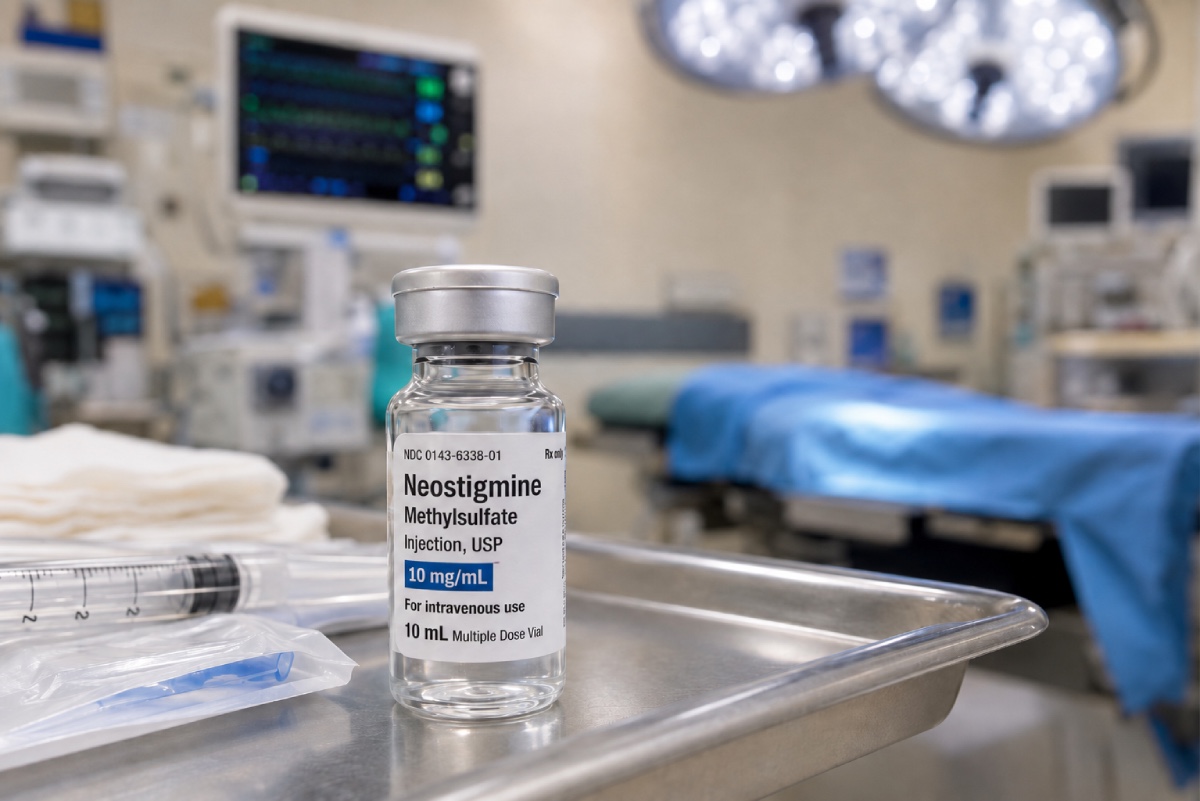
Neostigmine, an acetylcholinesterase inhibitor, was previously the primary agent for reversing non-depolarizing neuromuscular blockade (NMB) and remains an important tool in clinical practice. By inhibiting acetylcholinesterase, neostigmine allows acetylcholine to accumulate at the neuromuscular junction, outcompeting residual blocking agent molecules at nicotinic receptors and restoring transmission (Jones et al., 2008). In many clinical settings, sugammadex is now the preferred NMB reversal agent due to its more direct mechanism of action and greater efficacy, but despite its clinical drawbacks, neostigmine remains relevant thanks to several practical benefits.
The central drawback of neostigmine is its indirect mechanism, which depends on partial spontaneous recovery already being underway. It is not effective against profound or deep blockade and works reliably only once some neuromuscular transmission has returned (Jones et al., 2008). In a randomized comparison of neostigmine-glycopyrrolate against sugammadex for reversal of profound rocuronium block, patients receiving neostigmine took a median of 49 minutes to reach a train-of-four (TOF) ratio of 0.9, compared with 2.7 minutes for sugammadex, and nearly a quarter of neostigmine patients required more than an hour (Jones et al., 2008).
This slow and unpredictable recovery profile has been confirmed repeatedly: a 2015 systematic review found that patients given neostigmine were roughly twice as likely to show clinical signs of residual paralysis as those given sugammadex, and a 2017 Cochrane review calculated that sugammadex reversed moderate block over six times faster and deep block nearly seventeen times faster than neostigmine (Abad-Gurumeta et al., 2015; Hristovska et al., 2017).
Because neostigmine also stimulates muscarinic receptors throughout the body, it produces autonomic side effects—bradycardia, bronchoconstriction, and increased gastrointestinal secretions and motility—that typically require co-administration of an antimuscarinic agent such as glycopyrrolate or atropine (Jones et al., 2008). These combinations carry their own risks: the Cochrane review found neostigmine associated with substantially more bradycardia and postoperative nausea and vomiting (PONV) than sugammadex (Hristovska et al., 2017).
This finding is consistent with older literature; a 1988 trial in patients undergoing hip or knee replacement found that neostigmine plus atropine roughly doubled the incidence of postoperative nausea (68% vs. 32%) and quadrupled the incidence of vomiting (47% vs. 11%) compared with allowing spontaneous recovery, implicating neostigmine’s muscarinic gastrointestinal effects as a likely mechanism (King et al., 1988).
Beyond these established concerns, a large prospective observational study of nearly 3,000 patients found that neostigmine reversal did not improve oxygenation at PACU admission and was instead associated with a significantly higher incidence of postoperative atelectasis. High-dose neostigmine (>60 μg/kg) nearly tripled the odds of atelectasis and was linked to longer PACU and hospital stays, while neostigmine given without proper neuromuscular monitoring guidance was independently associated with pulmonary edema and reintubation (Sasaki et al., 2014). These findings emphasize the importance of proper dosing and monitoring following neostigmine for NMB reversal.
Despite these drawbacks, neostigmine has significant benefits. It is inexpensive and effective when given appropriately—at a shallow-to-moderate depth of block in an appropriate dose. Systematic reviews have found no significant difference between neostigmine and sugammadex in the rate of serious adverse events or critical respiratory complications, and neostigmine remains a reasonable choice where cost or drug availability limit access to newer agents (Abad-Gurumeta et al., 2015; Hristovska et al., 2017). Some research suggests that clinicians are more likely to rely on deeper neuromuscular blockade when sugammadex is available for reversal, potentially facilitating overmedication. Nonetheless, neostigmine’s slower, less predictable reversal and its muscarinic side-effect profile make it less attractive for NMB reversal when compared to sugammadex.
References
- Abad-Gurumeta, A., Ripollés-Melchor, J., Casans-Francés, R., Espinosa, A., Martínez-Hurtado, E., Fernández-Pérez, C., Ramírez, J. M., López-Timoneda, F., & Calvo-Vecino, J. M. (2015). A systematic review of sugammadex vs neostigmine for reversal of neuromuscular blockade. Anaesthesia, 70(12), 1441–1452. https://doi.org/10.1111/anae.13277
- Hristovska, A. M., Duch, P., Allingstrup, M., & Afshari, A. (2017). Efficacy and safety of sugammadex versus neostigmine in reversing neuromuscular blockade in adults. Cochrane Database of Systematic Reviews, 2017(8), CD012763. https://doi.org/10.1002/14651858.CD012763
- Jones, R. K., Caldwell, J. E., Brull, S. J., & Soto, R. G. (2008). Reversal of profound rocuronium-induced blockade with sugammadex: A randomized comparison with neostigmine. Anesthesiology, 109(5), 816–824. https://doi.org/10.1097/ALN.0b013e31818a3fee
- King, M. J., Milazkiewicz, R., Carli, F., & Deacock, A. R. (1988). Influence of neostigmine on postoperative vomiting. British Journal of Anaesthesia, 61(4), 403–406. https://doi.org/10.1093/bja/61.4.403
- Sasaki, N., Meyer, M. J., Malviya, S. A., Stanislaus, A. B., MacDonald, T., Doran, M. E., Igumenshcheva, A., Hoang, A. H., & Eikermann, M. (2014). Effects of neostigmine reversal of nondepolarizing neuromuscular blocking agents on postoperative respiratory outcomes: A prospective study. Anesthesiology, 121(5), 959–968. https://doi.org/10.1097/ALN.0000000000000440